Contact us
Products / Types of sensors
  • Temperature Sensors

    Sensors for measuring temperature.

  • Wireless Sensors

    Wireless battery sensors

  • Humidity + Temperature

    Humidity + temperature sensors

  • Duct Sensors

    Duct sensors optimize ventilation.

  • Industrial Sensors

    Industrial sensors ensure reliability.

  • VOC + humidity

    VOC + humidity sensors

  • CO2 + temperature

    CO2 + temperature sensors

  • CO₂ + VOC

    CO2+VOC sensors

  • Accessories

    Accessories facilitate the installation of sensors.

  • Refrigerant Leak Sensors

    Sensors for detecting refrigerant leaks.

  • Radon Sensors

    Radon sensors for direct ventilation control.

  • PMx Sensors

    PMX sensors monitor dust particles.

  • CO2 sensors

    CO2 sensors for air quality monitoring.

  • CO2 + humidity

    CO2 + humidity sensors

  • VOC Sensors

    VOC sensors detect harmful substances.

  • RH Sensors

    RH sensors measure relative humidity.

Latest news
    The Impact of VOCs on Health and Productivity in the Workplace

CO2 in Interiors – Real Measurements

CO2 is a colorless, odorless gas, approximately 1.5 times heavier than air. It is one of the most common indoor air pollutants, primarily because its source is mainly human activity.

Measurement of CO2 Concentration

The concentration of carbon dioxide is expressed in ppm (parts per million). For example, a measurement of 1,500 ppm means 1,500 particles in the air per million others. Sometimes it is also expressed in %.

Recommended Values

The so-called Pettenkofer criterion (Pettenkofer, 1858), which sets the maximum concentration of CO2 in indoor spaces at which a person still feels comfortable, is 1,000 ppm (0.1%). This value has also been adopted by the international organization ASHRAE – a professional society with more than 50,000 members focused on building technology and systems, particularly in heating, ventilation, and air conditioning. It supports technical education, participates in certifications and standardization, publishes the ASHRAE Journal, and releases research report summaries and conference information.

A CO2 concentration value of 1,000 ppm in interiors is thus the upper limit for quality indoor air in the USA. Higher concentrations usually lead to fatigue and lack of concentration among the people present; in worse cases, it can cause headaches or dizziness. Air with a carbon dioxide concentration above 1,500 ppm (= the threshold value in the Czech Republic) is considered stale air.

Although the safe limit for carbon dioxide concentration that does not pose serious health risks to humans is 5,000 ppm, it is important to maintain CO2 concentration below one thousand ppm.

Specific Measurements

To determine the actual CO2 concentration values in places where people spend most of their time, our company installed air quality sensors in two kindergarten classrooms, one elementary school classroom, and two offices.

Kindergarten

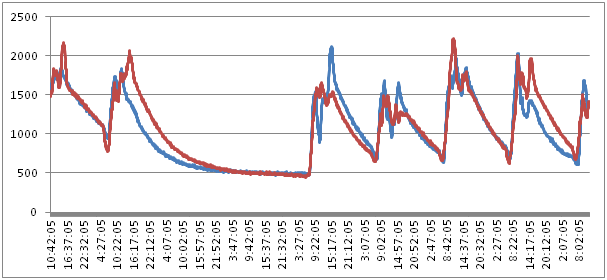
Measurements were taken in two classrooms of the same size, 8 x 7 m, which accommodated a group of about 24 children and teachers. Because these were relatively large rooms where children, who produce lower amounts of CO2, spent time, the rooms were well-ventilated, and the children often spent time outside these rooms (morning walks, lunch, and nap time), the CO2 value rarely exceeded 2,000 ppm. Nevertheless, values often exceeded 1,500 ppm – the mandated value at which ventilation is required in the Czech Republic.

grafskolka

Figure 1: Measurements in the kindergarten (large drop = weekend, smaller drops = night, CO2 decreases during the day = walks, lunch,…)

Elementary School

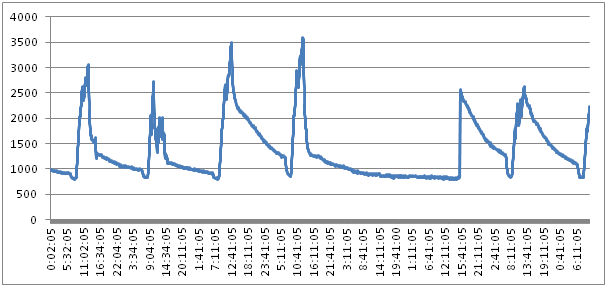
Measurements at the elementary school were conducted in the 1st grade (i.e., children aged 6-7 years) in a classroom measuring 8.5 x 9 m. The classroom was therefore larger than in the kindergarten, with about 26 children, and only small breaks occurred, during which the classroom could not be ventilated to a tolerable CO2 concentration. Values during the day typically exceeded 2,000 ppm and several times reached above 3,000 ppm. This fact may also explain the frequent fatigue and inattention of the children during lessons.

"Figure

Figure 2: Measurements in the school (large drop = weekend, smaller drops = night, CO2 decreases during the day = walks, lunch,…)

Office

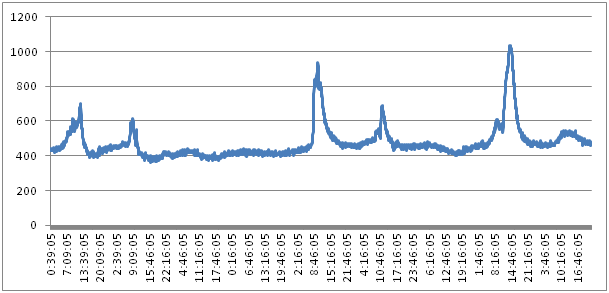
The measured values in the office were the lowest of all measurements. This fact is due to the ventilation system implemented in the company. Additionally, it is a relatively large room (6 x 7.5 m) with high ceilings and a low number of workers present.

grafkancl Figure 3: Measurements in the office