Forced ventilation systems generally operate based on so-called time control, which means that the volume of exchanged air depends on time intervals. In this case, there can sometimes be situations where the air is exchanged more intensively than necessary. This is a downside of controlled ventilation – it leads to over-drying of the air and also to energy wastage. However, even this single downside can be resolved with a more efficient ventilation method – ventilation controlled by actual demand.
You might be wondering what is meant by the term “actual demand”? Simply put, it refers to the necessary amount of air that needs to be brought into the interior based on real requirements. Systems controlled by actual demand are essentially two – VAV and DCV.
The DCV system (from English Demand Controlled Ventilation) is a continuous ventilation control system using air quality sensors. Its immediate performance is therefore dependent on the current air quality. The DCV system has dampers on the supply duct that are continuously adjustable. Each damper has its own air quality sensor, which continuously controls the necessary amount of supply air with its analog signal. The advantage is a more constant quality of indoor air, while the disadvantage is higher investment costs for the servomotors of the dampers with continuous control capability.
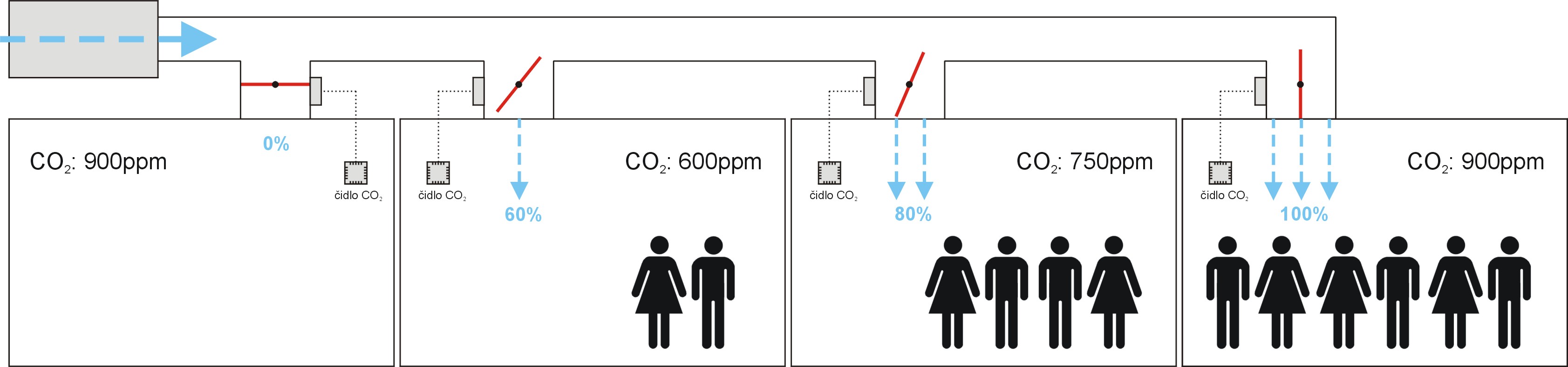
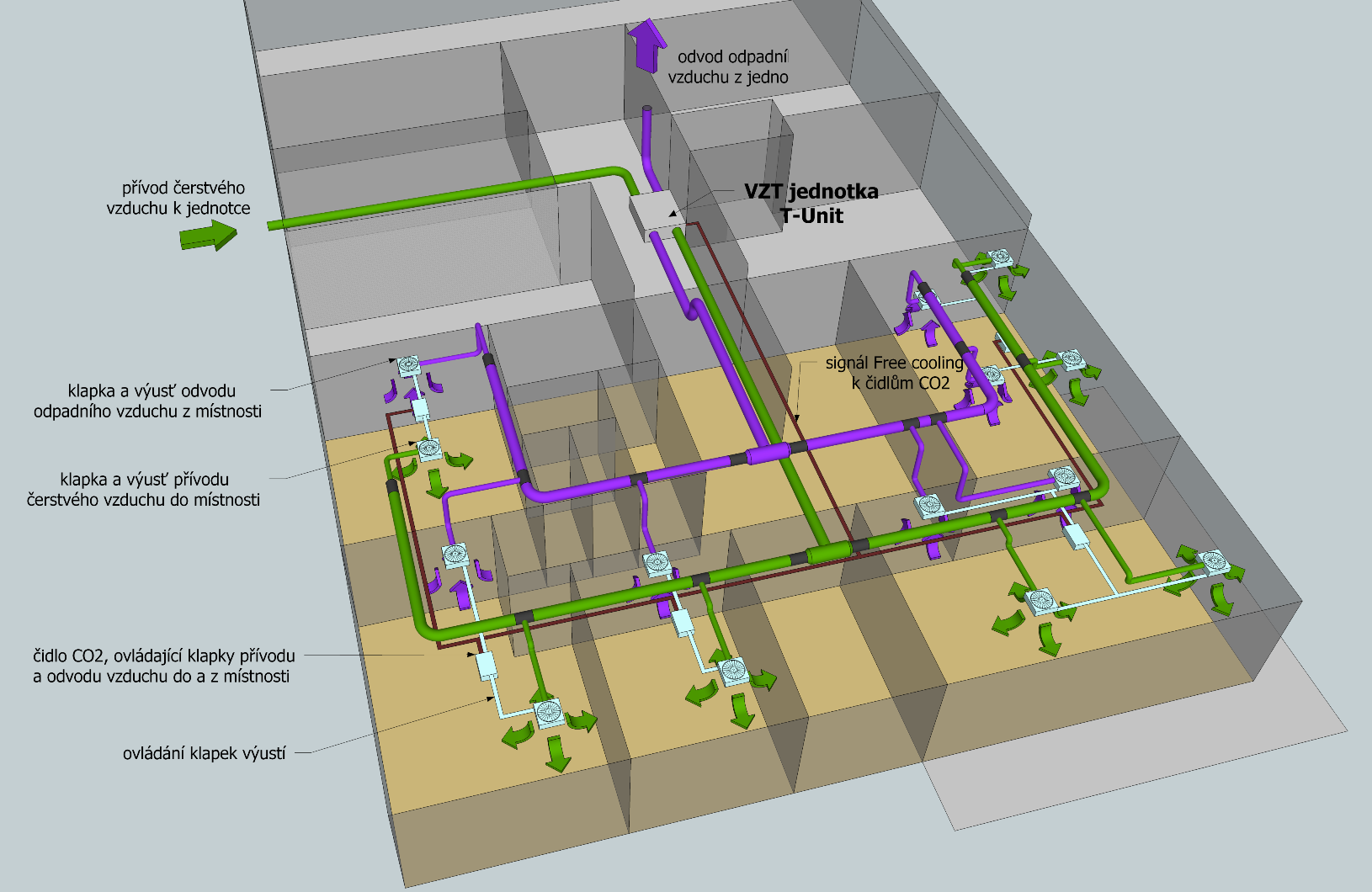
VAV stands for Variable Air Volume, which means ventilation with variable air volume. This ventilation system is used for ventilating office spaces directly in our company. Ventilation is provided by a recovery unit with a plate counterflow heat exchanger and control electronics developed in-house. This unit operates in a mode that maintains constant pressure in the outlet/supply duct to individual offices.
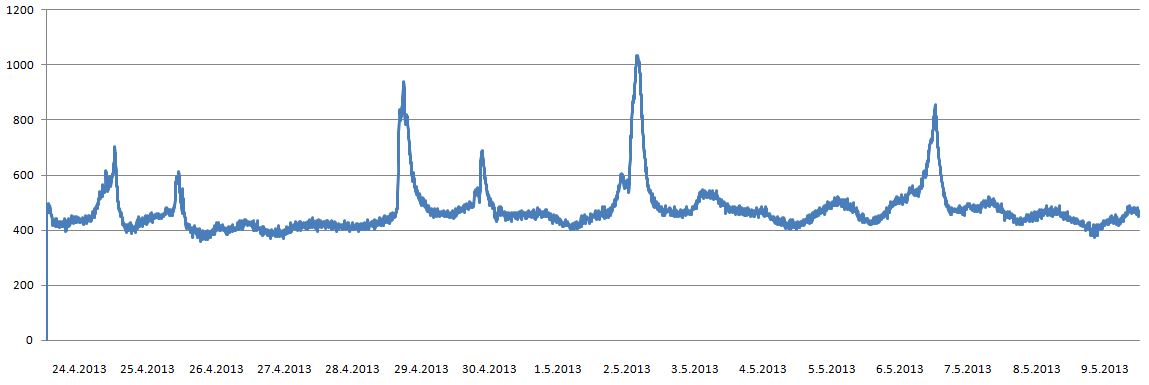
Each office is equipped with one carbon dioxide sensor and a damper on the duct. The supply damper in each office is controlled by a control servomotor, which is regulated by the CO2 sensor. If all offices are empty and contain unexhaled air, the recovery unit operates at minimal performance because all dampers are closed, and the required pressure in the duct is easily achieved. When people enter the office, the concentration of CO2 gradually begins to rise, and upon exceeding the preset concentration level (in our case, 950 ppm), the sensor sends a command to open the supply damper. As a result, the pressure in the supply duct drops, and the recovery unit automatically increases its performance (trying to maintain the preset pressure in the supply duct) and thus begins to ventilate the office that has stale air. Once the concentration of CO2 falls below the lower limit (in our case, 800 ppm), the supply and exhaust dampers close again, and the respective office stops being ventilated. This is how individual offices are ventilated, and the performance of the recovery unit, or the demand for the total required amount of air, is communicated to the recovery unit through the current pressure in the supply duct.
The dampers in individual offices are equipped with a type of servomotor that only provides open/close control of the dampers, thus not allowing for continuous adjustment of the closing damper positions.
During the first startup of the system, it was necessary to set the system so that each office was ventilated with a sufficient amount of air based on the number of people working in it.
The regulation of the ventilation system was performed by first fully opening all dampers in all offices and measuring the amount of incoming air in the furthest office. Then, the pressure in the supply duct behind the ventilation unit was gradually increased to achieve the necessary air supply to this furthest office based on the number of people working in it.
Then, the procedure moved towards the ventilation unit through each office, ensuring that the necessary amount of supply air was always set by adjusting the maximum open position of the supply and exhaust dampers. The maximum opening angle of the supply and exhaust dampers was thus individually set for each office using an adjustable end stop. The ventilation unit was then switched to normal operating mode, where the required pressure in the supply duct was set to the value that was determined during the initial regulation.