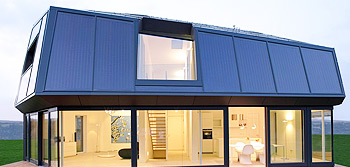
These homes utilize passive energy sources, such as light bulbs, computers, televisions, and human heat. For example, one adult “heats” the interior with an output of about 200 watts, and when there are four people in the household, or even better in a school where there are twenty children in a classroom, it becomes noticeable.
Furthermore, in heat exchangers with heat recovery, heat from the exhausted (polluted) air is transferred to the fresh cold air. Thus, at an indoor temperature of 20 °C and an outdoor temperature of 0 °C, fresh air can be heated up to 17 – 18 °C. For heating, because in freezing temperatures some additional heating is necessary, you would spend only about five thousand crowns annually instead of forty thousand.
Passive houses are not yet widespread in our country, with their construction accounting for only a few percent. In contrast, Germany and Austria are significantly ahead, where about ten percent of such houses are already being built.
The alpha and omega is measurement. This is where air quality sensors come into play. Sensors allow for easy and inexpensive continuous measurement of indoor air quality, for example, by monitoring the concentration of CO2 in the air, and based on the obtained values, ventilation systems can be controlled to ensure good air quality while minimizing energy consumption. Such systems are particularly useful for spaces with a variable number of people. The ventilation performance then continuously changes depending on the number of people present in the ventilated space. High concentrations of carbon dioxide induce exhausted air, which then causes fatigue, drowsiness, reduces concentration, etc. Consequently, productivity dramatically decreases in such a space.