Contact us
Products / Types of sensors
  • Temperature Sensors

    Sensors for measuring temperature.

  • Wireless Sensors

    Wireless battery sensors

  • Humidity + Temperature

    Humidity + temperature sensors

  • Duct Sensors

    Duct sensors optimize ventilation.

  • Industrial Sensors

    Industrial sensors ensure reliability.

  • VOC + humidity

    VOC + humidity sensors
  • CO2 + temperature

    CO2 + temperature sensors

  • CO₂ + VOC

    CO2+VOC sensors

  • Accessories

    Accessories facilitate the installation of sensors.

  • Refrigerant Leak Sensors

    Sensors for detecting refrigerant leaks.

  • Radon Sensors

    Radon sensors for direct ventilation control.

  • PMx Sensors

    PMX sensors monitor dust particles.

  • CO2 sensors

    CO2 sensors for air quality monitoring.

  • CO2 + humidity

    CO2 + humidity sensors

  • VOC Sensors

    VOC sensors detect harmful substances.

  • RH Sensors

    RH sensors measure relative humidity.

Latest news
    The Impact of VOCs on Health and Productivity in the Workplace

Measuring CO2 is often not enough

Indoor air quality today is assessed based on temperature, humidity, and primarily on the concentration of Carbon Dioxide (CO2). However, people often complain about air quality even when all these indicators show optimal levels. This is because comfort in indoor environments is reduced not only by high concentrations of CO2, but also by various odors, vapors, etc. Most of these substances that we perceive by smell (including those we cannot identify) fall into the category of so-called volatile organic compounds.

measuring co2 - young family in the living room

VOC – Volatile Organic Compounds

Volatile Organic Compounds, or VOC (from the English Volatile Organic Compounds), are chemical substances that are released as gases from solids or liquids and easily evaporate into the air at room temperature. The concentration of these substances can be up to 100 times higher indoors than outdoors.

Many products that we use or are exposed to every day emit VOCs into the air. These can include various cleaning agents, fumes from frying and cooking, perfumes, vapors from paints and furniture, etc. While all VOCs have the potential to be harmful, there are several VOCs that can be particularly dangerous and are still emitted from a range of products in our homes – such as formaldehyde, benzene, and phenol. Even slightly elevated levels of airborne chemicals can cause health problems for people, especially young children, the elderly, pregnant women, and those suffering from allergies and asthma.

Measuring CO2 vs. measuring VOC

Ventilation based on Carbon Dioxide concentration plays an important role in managing modern ventilation systems. This gas, as mentioned, is not the only (nor the most harmful) substance in the indoor environment. Carbon Dioxide itself is not dangerous to humans at low concentrations, but it is well measured and its concentration rises comparably with the concentration of other substances when spaces are polluted by people – hence it was chosen as a reliable indicator for assessing air quality.

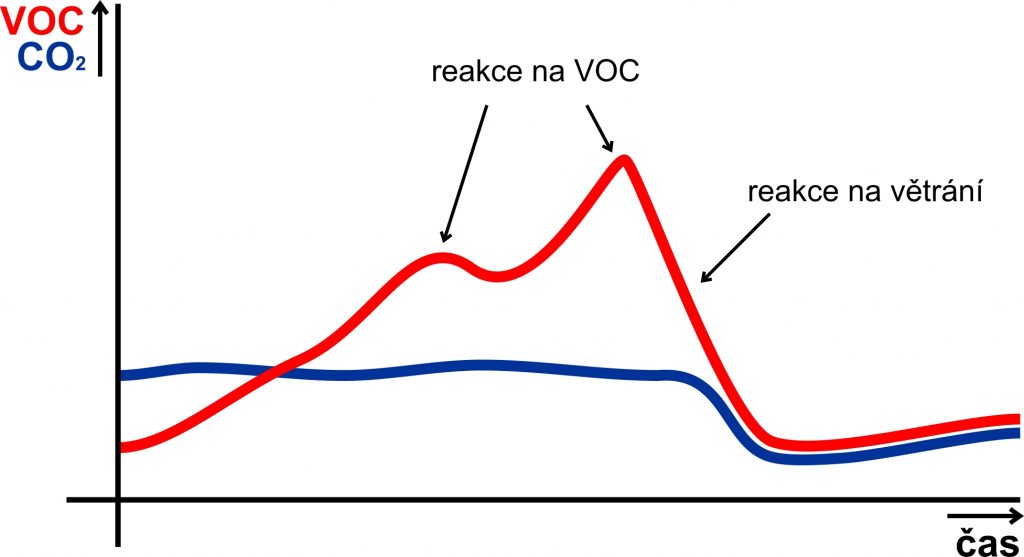
Real measurements show that an increased concentration of pollutants in the air does not necessarily mean an increased concentration of CO2, and yet the air contains many health-hazardous substances. Logically, the ventilation system should respond to this situation as well, not just to the concentration of CO2.

Sensors for Monitoring Indoor Air Quality

To measure air quality not only based on CO2, “air quality sensors,” generally referred to as volatile organic compound sensors. These sensors are said to measure in a way that approximates human perception of odors. In addition, the sensors detect substances that people do not perceive by smell.

The wide range of detectable gases allows for monitoring various concentrations of gases, simplifying air quality monitoring. The detected concentration ranges from units of ppm to thousands of ppm. These features make these sensors suitable for use in low-demand spaces such as homes, social spaces, schools, gyms, etc.

CO2

VOC

Schools

x

Social spaces

x

Offices

x

Residential spaces

x

x

Changing rooms

x

Canteens

x

Kitchens

x

Gyms, fitness centers

x