Contact us
Products / Types of sensors
  • Temperature Sensors

    Sensors for measuring temperature.

  • Wireless Sensors

    Wireless battery sensors

  • Humidity + Temperature

    Humidity + temperature sensors

  • Duct Sensors

    Duct sensors optimize ventilation.

  • Industrial Sensors

    Industrial sensors ensure reliability.

  • VOC + humidity

    VOC + humidity sensors

  • CO2 + temperature

    CO2 + temperature sensors

  • CO₂ + VOC

    CO2+VOC sensors

  • Accessories

    Accessories facilitate the installation of sensors.

  • Refrigerant Leak Sensors

    Sensors for detecting refrigerant leaks.

  • Radon Sensors

    Radon sensors for direct ventilation control.

  • PMx Sensors

    PMX sensors monitor dust particles.

  • CO2 sensors

    CO2 sensors for air quality monitoring.

  • CO2 + humidity

    CO2 + humidity sensors

  • VOC Sensors

    VOC sensors detect harmful substances.

  • RH Sensors

    RH sensors measure relative humidity.

Latest news
    The Impact of VOCs on Health and Productivity in the Workplace

Project Testing with Prague Students

O2 IT Services (O2 ITS), a subsidiary of O2 Czech Republic, is launching a pilot project Smart City “Environment – Healthy School” in collaboration with several partners, focusing on air quality measurement. This highlights the issue of optimal living conditions in schools and their impact on the health and attention of students and teachers. The project was initiated in February 2017 and lasted several months.

The trial operation will take place at Smíchov Secondary Industrial School (SSPŠ), which is ideally suited for testing in the challenging conditions of urban development and heavy road traffic due to its structure and location. An additional advantage is that it is a technically oriented school that wants to utilize the measurement results in its vocational training.

“With the Healthy School project, we would like to open a discussion on the topic of quality living conditions in cities and their impact on our health. We believe that the use of innovative technologies can significantly contribute to its improvement,” says Václav Provazník, Managing Director of O2 IT Services.

“From our participation in the project, we expect not only an improvement in the quality of the indoor environment for our students and school staff, but we also greatly welcome the opportunity for students to engage in measurements and experiments. The practical experience with new technologies that students can gain through O2 ITS is invaluable,” says Radko Sáblík, Principal of SSPŠ.

How It Works

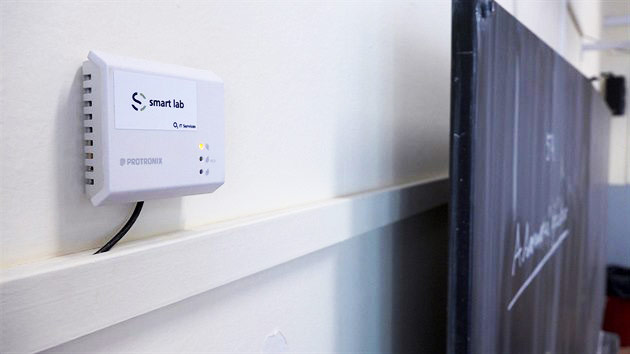
The subject of the pilot project is long-term measurements of the indoor environment in selected classrooms and the external environment outside the school towards the street and the internal courtyard. Sensors are installed in ten classrooms that continuously measure the levels of indoor air pollution through the concentration of Carbon Dioxide (CO2) in the air, relative humidity, and temperature. At the same time, two sensors are placed in the school to measure the level of pollution in the external environment through particulate matter.

Additionally, noise levels are measured at several locations in front of the school windows. During the pilot project, a series of experiments will be conducted to verify the impact of the testing measures on changes in the indoor environment of the school.

The individual sensors transmit real-time data (temperature, CO2 levels, humidity, etc.) to the internal system of O2 ITS 24 hours a day, allowing the climate in the classrooms to be monitored at any time. Selected students also record specific data about events in the classroom, such as time or the number of students. Thanks to this data, it will be possible to analyze the measurement results in detail and provide specific recommendations.

Project Benefits

After the pilot operation concludes, O2 IT Services, together with the project partners, will conduct an analysis that describes the relationship between the levels of pollution in the indoor and outdoor environments and specific situations in the school. The analysis will also include proposals for individual steps that would enable the school to manage the environmental situation during the presence of students and teachers in the school building. Another benefit will be the verification of technology and the determination of the necessary range of components for smart environmental management in buildings.


Project Partners

The project includes the following technology companies that focus on environmental areas and smart cities:

PROTRONIX s.r.o. – provided room sensors to monitor air quality indoors. The sensor measures the concentration of Carbon Dioxide (CO2) in the range up to 5000 ppm, temperature, and relative humidity.
CAMEA, spol. s r.o. – installed two devices on the school building facing the street and the courtyard for fully automatic informative monitoring of external air pollution; the sensors measure particulate matter and the concentration of Carbon Monoxide (CO) in the air, alongside basic parameters such as temperature, humidity, and air pressure.
IQRF Alliance s.r.o. – connected individual industrial partners and academic institutions using the IQRF communication platform. The companies O2, Protronix, and MICRORISC are members of the IQRF Alliance.
MICRORISC s.r.o. – provided IQRF transceivers creating a transmission system that ensures wireless transmission of sensor data.


Environmental Protection, s.r.o. – conducts accredited measurements and provided a noise sensor within the pilot project that will continuously measure and record the equivalent level of acoustic pressure at various locations in front of the school windows.

For more information, visit www.o2its.cz and www.smartcity.cz


Source:
http://ekonomika.idnes.cz/o2-meri-ve-skole-vzduch-smart-city-dlg-/ekoakcie.aspx?c=A170303_130107_ekoakcie_rny