These sensors operate on the principle of measuring the attenuation of infrared radiation (at a specific wavelength) in the air. The sensors consist of an infrared radiation source (bulb), a light-guiding tube, and an infrared detector with an appropriate filter. The signal from the infrared detector is then amplified and the attenuation of the radiation, caused by collisions with carbon dioxide, is evaluated using additional electronics. Based on this, the current concentration of CO2 in the air is calculated. To simplify – the more CO2, the more the infrared radiation is attenuated.
NDIR sensors are generally very accurate and long-term stable. An advantage is that they measure concentration from zero value and can handle high concentrations of CO2. Currently, we have the NDIR principle applied in all carbon dioxide concentration sensors. Their stability and lifespan exceed 10 years.


These sensors typically consist of an electrochemical cell with a solid electrolyte (= solutions or melts that conduct electric current). This cell is heated to operating temperature by additional heating. Chemical reactions occur at the electrodes of the cell similar to those in a fuel cell, where oxygen is consumed and an electromotive force is generated at the electrodes. By measuring this electromotive force using special electronics, the concentration of CO2 in the air is determined. The main advantage of these sensors is their high sensitivity and excellent selectivity for carbon dioxide. They are usually cheaper than NDIR sensors, but with significantly lower lifespan (about 2 years) and accuracy. Therefore, we have moved away from these sensors. Sensors operating on the electrochemical principle work only from about 400 ppm, which is not an issue considering the concentration in outdoor air, which is around 360-400 ppm.
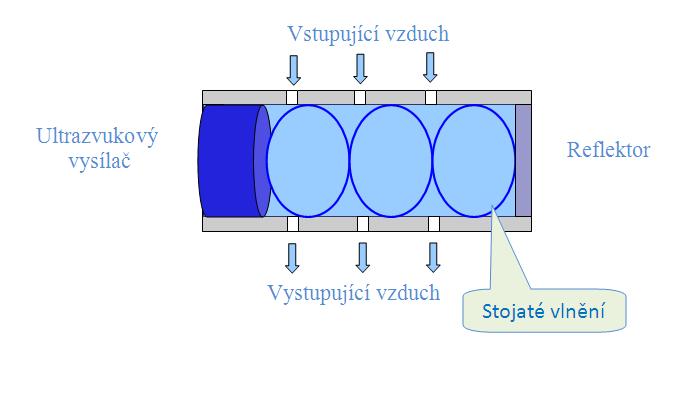
Electroacoustic sensors operate on the principle of evaluating frequency changes of ultrasound in a mechanical resonator. Using electronics, the change in frequency of the ultrasonic waves is evaluated, and based on the dependence of the frequency change on the concentration of CO2 in the air, the current concentration of CO2 is determined.
The main advantage of these sensors is long-term stability without the need for recalibration.
Sensors of all types typically have a continuous voltage output (0-10 V) or current output (0-20 / 4-20 mA), through which they transmit information about the concentration value of CO2 in the air to the superior ventilation system.